
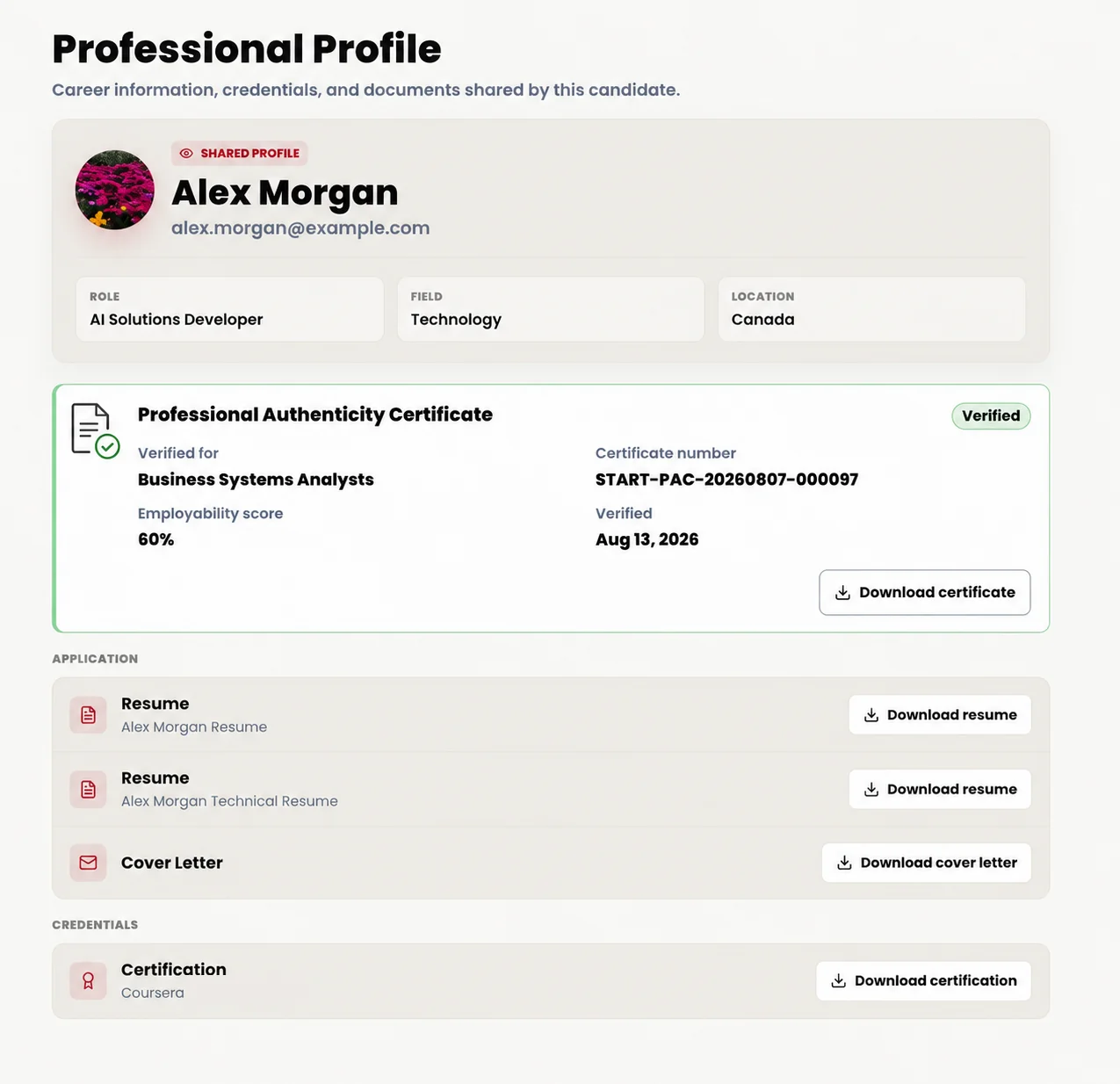
LinkedIn no longer offers skill assessments, and its help page says the badges and all related data were set to be removed from member profiles in 2024. To prove your skills now, use evidence someone else can check: work samples, a vendor certification, a course certificate, an employer's own test, or a verified score and certificate you share by link, such as START's Employability Score and Professional Authenticity Certificate.
What LinkedIn actually said
LinkedIn's help article on Skill Assessments now carries the heading "no longer available." It gives a reason: hirers increasingly value examples of how a candidate applied a skill, and members can now tag skills to credentials and link them to specific jobs, projects or education on their profile. So LinkedIn is discontinuing assessments in its jobs products, and "All badges from completed Skill Assessments will also be removed from member profiles in 2024," along with all the data tied to them.
The page gives no day or month for the shutdown, only a relative "last updated" note, so 2024 is the one firm date. If you had a Python or Excel badge, it is gone.
Take the hint and build your proof around applied skill.
Option 1: portfolios and work samples
A portfolio shows the work itself, and nothing else on this list does that. A hiring manager for a junior data analyst role can open your notebook and judge your SQL in minutes.
On GitHub you can pin up to six repositories and gists so visitors see your best work first. Pin fewer, better projects, each with a README that states the problem, your approach and the result.
Not in a technical field? Write short case studies instead. A project coordinator can show a real schedule, a risk log and a one-page summary of what changed. A marketer can show a campaign brief and the numbers it moved. Remove anything confidential from a past employer before you share it.
A portfolio only works if someone reads it, so pair it with something faster to scan.
Option 2: vendor certifications
Vendor certifications are proctored exams run by the company that makes the technology. They prove you know that vendor's platform at a stated level.
- Microsoft Certified: Azure Fundamentals is a beginner certification with a 45 minute proctored exam. Microsoft prices it by the country where you take the exam, and you can share a transcript link with employers.
- AWS Certified Cloud Practitioner costs 100 USD, runs 90 minutes and is valid for three years. AWS issues digital badges through Credly, and its certification FAQ tells employers to ask the earner for the badge link to verify it.
- Google Cloud's Associate Cloud Engineer has a $125 registration fee plus tax where applicable, a two hour exam and a three year validity period.
The catch is scope. An Azure certificate says you know Azure, not that you can run a meeting or handle a client call. Pick the one named in the job postings you are applying to.
Option 3: course certificates
Course certificates prove you finished a structured program, which helps a career changer fill an obvious gap on a resume.
The Google Data Analytics Professional Certificate on Coursera is an eight course, beginner program that Coursera estimates at six months at 10 hours a week. As listed in October 2026, Coursera charges $49 a month in the U.S. and Canada after a 7-day free trial and says most learners finish for less than 300 USD. Graduates can claim a Credly badge.
An edX verified certificate confirms you completed an online course, with individual courses from as little as $50 as listed in October 2026.
The issuers describe them as proof that you completed a course, which is different from passing a proctored exam. Use them to support a portfolio project, such as a capstone dashboard you can show, rather than as proof on their own.
Option 4: employer-run tests
Some employers test candidates themselves. TestGorilla describes itself as "the proof-first AI recruiting platform," and it is sold to employers and recruiters, who choose the tests. Its Profiles page says candidates can also sign up on their own, and that recruiters see how you rank against everyone else who took a test.
You don't control these tests. The employer picks them and sets the bar, so prepare for them, but don't count on them to carry your proof to the next application.
Option 5: a verified score and certificate you control
What the list above lacks is one portable record of technical and workplace skills, checked by someone other than you, that you can send to any employer. That is what START Canada built.
The Employability Score Platform has more than 10,000 assessment questions across technology, business and soft skills, at Junior, Intermediate and Expert levels. You can verify yourself against a specific job role through role assessments. Results appear as soon as an assessment ends, with your strengths and gaps, and a results history shows your progress over time. AI-powered recommendations suggest what to work on next.
Your Professional Profile and Professional Authenticity Certificate bring together your resume, education and industry credentials, achievements, Employability Score results and a short self-introduction video. A START reviewer checks the evidence, including your resume, verified role and scores, before marking the certificate "START verified." The certificate confirms the role you were assessed for and your readiness score. You choose what employers see and share it by link.
Because your industry credentials sit in the same profile as your scores, an employer gets one link instead of six.
How the options compare
| Option | What it proves | Who checks it | Cost signal, October 2026 |
|---|---|---|---|
| Portfolio or case studies | You can do the work on a real problem | The hiring manager who reads it | No exam fee, only your time |
| Microsoft Azure Fundamentals | Foundational Azure knowledge | Proctored exam, employer views your transcript link | Priced by exam country |
| AWS Certified Cloud Practitioner | Foundational AWS cloud knowledge | AWS, employer verifies your Credly badge link | 100 USD plus tax |
| Google Cloud Associate Cloud Engineer | Associate-level Google Cloud knowledge | Proctored exam | $125 plus tax |
| Coursera or edX certificate | You completed a structured course | The course platform | Coursera $49 a month in the U.S. and Canada, edX courses from $50 |
| Employer-run test such as TestGorilla | How you rank on tests that employer chose | The employer | Set by the employer |
| START Employability Score and Professional Authenticity Certificate | Scores across technical, business and soft skills, plus readiness for a verified role | A START reviewer, then the employer you share it with | Contact START |
A strong application combines a work sample that shows the skill, a credential that backs it and a verified record that ties them to the role. For more on what happens on the employer's side, read how employers verify candidate skills.
Frequently asked questions
Are LinkedIn skill assessments coming back?
LinkedIn's help page says they are no longer available and points members toward showing skills on their profile instead. Nothing on the page suggests a return.
What happened to my old LinkedIn skill badge?
LinkedIn said all badges from completed assessments would be removed from member profiles in 2024, along with all associated data. If a skill mattered to you, prove it again with a work sample or a certification.
Which certification should I get first?
Read 10 job postings for the role you want and count which credentials they name. If most mention AWS, start with Cloud Practitioner. If they ask for analysis skills without naming a vendor, a portfolio project will usually do more for you than another certificate.
How does an employer check a certificate I list on my resume?
It depends on the issuer. AWS asks employers to request your Credly badge link, and Microsoft lets you share a transcript link. With START, you send one link to your profile, and the certificate shows it was checked by a START reviewer.
Can I take employer tests like TestGorilla on my own?
TestGorilla says you can sign up for a profile yourself, but the tests that count for a specific job are the ones the employer chooses and sends.
If you want one link that shows an employer what you can do and the role you're ready for, start with the Employability Score assessments, then build your Professional Profile and certificate around the results.
START Canada Team
The START Canada Team shares current information about the projects, training, and career-readiness tools described on startnew.ca.