
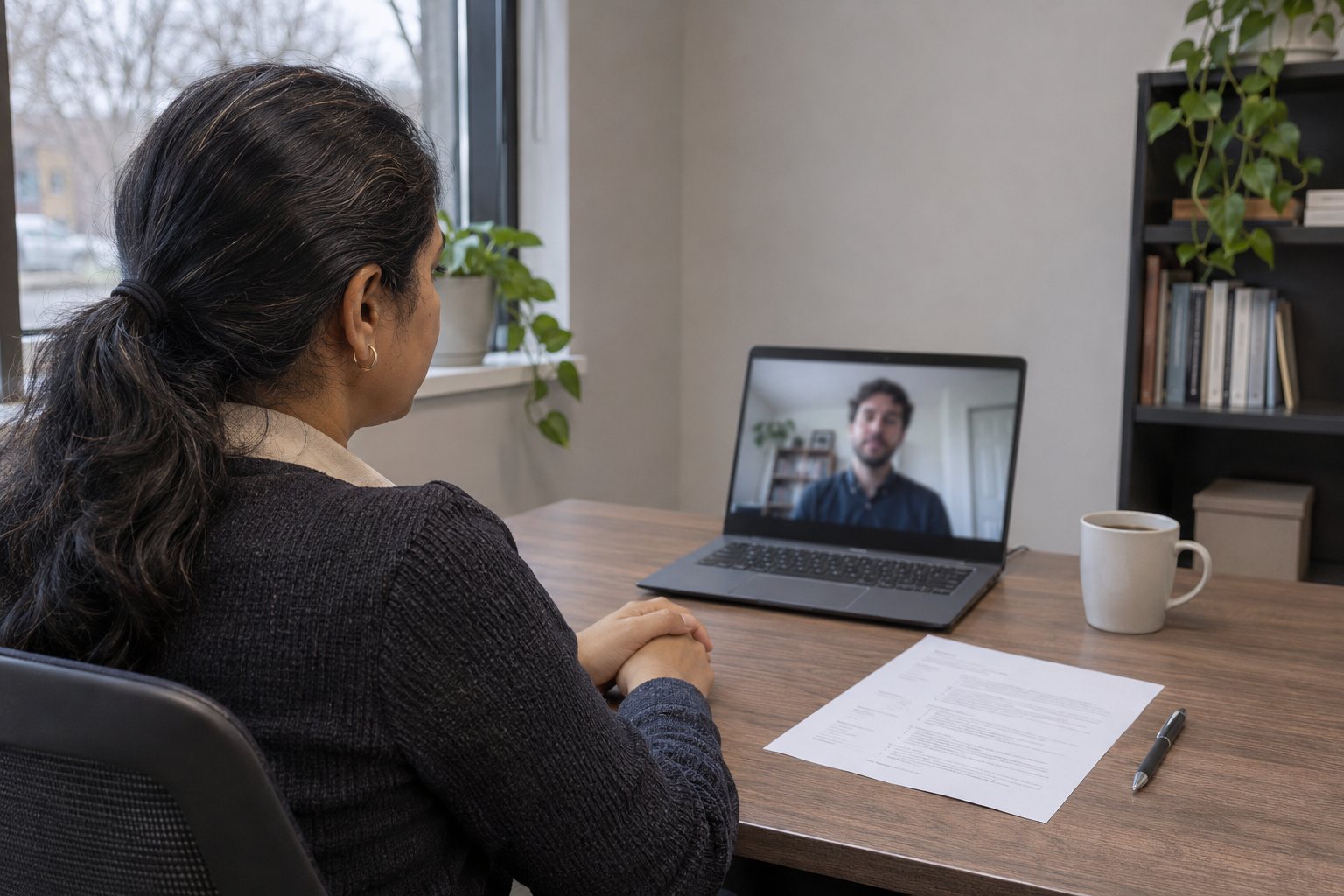
You tell a real candidate from a fake one by checking the person, not the paperwork. Test skills live on camera, make sure the same person appears at every stage, verify government ID against the face in front of you when you make a conditional offer, and, with the candidate's consent, confirm references through contacts you find yourself. Run those steps the same way for every finalist, and a fake candidate has far fewer places to hide.
What fake candidates look like now
A borrowed or stolen identity is the oldest form. In a June 2022 announcement, the FBI's Internet Crime Complaint Center said pre-employment background checks had found that personal details some applicants gave belonged to someone else. The same notice described deepfake interviews, where the lip movement on camera did not match the audio and a cough was heard with nothing happening on screen.
A proxy interviewee is a different person on the call. One person interviews well, and someone else shows up to do the job. In January 2025, the FBI said North Korean IT workers had used AI and face-swapping technology in video interviews to hide who they were.
AI-written applications are the grey zone. A Gartner survey of 3,290 candidates in late 2024 found 39% used AI while applying, most often to write resume text. That alone is not fraud. The problem is a polished resume describing someone who does not exist.
How common is it?
Gartner's July 31, 2025 release reported that in a survey of 3,000 job candidates in the second quarter of 2025, 6% admitted to interview fraud, either posing as someone else or having someone else pose as them. Gartner predicts that by 2028, one in four candidate profiles worldwide will be fake.
At its HR Symposium in London in October 2025, Gartner added that those profiles will "contain material identity misrepresentation." It said most organizations are turning to video interviews, 81%, and in-person interviews, 74%, which may help catch fraud but won't prevent it. Candidates seem to welcome it: 62% said they are more likely to apply when the interview is in person.
In Canada, the RCMP, Public Safety Canada, Global Affairs Canada, FINTRAC and the Canadian Centre for Cyber Security issued a joint advisory on July 16, 2025 about North Korean IT workers getting hired by Canadian businesses. One line is aimed squarely at smaller employers: "Small businesses and start-ups can be more attractive targets." Its red flags include reluctance to join voice or video calls, slow or missing ID documents, inconsistent personal details and deepfake technology in meetings.
A screening process that works for a small team
You don't need a fraud platform, just a fixed order of checks used every time.
1. Say what you check, up front
Put one line in the posting: finalists complete a live skills exercise, and the person who gets an offer confirms their identity and agrees to reference and background checks. Gartner's framework calls this the deter step. Honest candidates won't mind.
2. Screen applications for patterns
The FBI suggests cross-checking applicants for the same resume text or contact details under different names, because the same phone numbers and emails have turned up on several resumes. Kelly Services, in a November 2026 article, adds a reverse image search on the headshot and a quick check that past employers exist.
3. Test the skill live, on camera
Ask for camera on and background blur off, then watch the candidate work through a real task. A bookkeeper reconciles a short statement. A developer walks through a bug fix. Then ask about a project on their own resume. The FBI also suggests casual questions about the candidate's stated city or school. For designing the exercise itself, see how employers verify candidate skills.
4. Keep the same person in view
Proxy fraud depends on handoffs. Kelly recommends a short joint call with the recruiter, hiring manager and candidate so everyone sees the same face. The FBI advises completing as much of hiring and onboarding in person as possible, so hold the final round on site if you can.
5. Verify identity at the offer stage
Check government photo ID against the live person when you make a conditional offer, before the person starts or gets system access. Earlier asks too much of people you won't hire, and the Ontario Human Rights Commission advises asking for a driver's licence only when the job needs one, and only after a conditional offer. After the start date is too late. Don't ask for a Social Insurance Number yet. Employment and Social Development Canada says employers don't need it until they hire the person and they start working. Background checks, with written consent, also belong here. For which checks fit which role, see background checks in Canada.
6. Check references through your own channels
With the candidate's consent, look up the former employer's main number yourself and ask for the reference by name. A reference who answers a mobile number listed only on the resume proves very little.
7. Watch onboarding
The FBI flags changes to address or payment platforms during onboarding, and Kelly warns about requests to ship a work laptop somewhere other than the resume address.
| Stage | What you check | What it tends to catch |
|---|---|---|
| Application | Repeated text, phone numbers and photos; real past employers | Fabricated and mass-produced profiles |
| Live skills check | The candidate does the work on camera | Inflated AI-written claims, rehearsed or fed answers |
| Joint call or in-person round | The same person at each step | Proxy interviewees |
| Offer | Photo ID against the live person, consented background checks | Stolen or borrowed identities |
| Onboarding | Address, banking and laptop shipping | Payroll and equipment schemes |
Keep records that respect privacy
Write down which checks you ran, who ran them and when, so you can show every candidate got the same treatment. The federal Privacy Commissioner's guidance on employee records, written for federally regulated employers, says they may only collect the personal information necessary for the purpose they've identified, and keep it only as long as necessary. It's a sound rule for any employer. A note reading "passport sighted on video, name and photo match" usually serves you better than a stored scan.
Where START fits
A START verified Professional Authenticity Certificate means a START reviewer checked that the profile evidence belongs to the candidate and holds together: the name matches the account, the resume is theirs, the uploads are real documents, and the verified role comes from START's own assessments rather than a resume claim. When the candidate includes the certificate in their profile link, it opens in a browser with no account needed.
The START review does not check ID documents. For identity, candidates living in Canada can run Self Check Verification through Canpro Technologies, where the checks they can choose include ID verification along with criminal record, employment, education and credential checks. Canpro holds the reports, and the candidate decides whether to share them with you, so ask for the ID verification report specifically. Both give you a head start, and your live skills check and offer-stage ID check still apply.
If you think you've hired a fake candidate
Cut the person's system access, then report it. The Canadian Anti-Fraud Centre takes reports online and advises victims to contact local police too. If you suspect the person is one of the North Korean IT workers the RCMP advisory describes, the advisory warns of legal consequences under Canadian sanctions and says suspected sanctions violations must be reported to the RCMP National Security Information Network, at rcmp.ca/report-it. That is a separate report from the fraud report. Get legal advice early.
Frequently asked questions
How can you tell if a video interview is a deepfake?
Watch for lip movement that drifts from the audio, sounds with no matching movement, and warping around the face or hands when the person moves. A live task tied to their own resume is much harder to fake than a rehearsed answer.
When should an employer verify a candidate's identity?
At a conditional offer, against the live person, before anyone gets system access or payroll. Collecting ID from every applicant gathers data you don't need, and waiting past the start date gives a fake hire time inside your systems.
Is a START verified certificate an identity check?
No. It confirms a START reviewer checked that the candidate's profile evidence belongs to them and that the verified role came from START's assessments. Identity comes from a Self Check ID verification report the candidate chooses to share, or from your own check at the offer.
If you hire entry-level talent, newcomers or career changers and want candidates to arrive with verified evidence before the first interview, the START for employers page shows what a shared profile and certificate look like.
START Canada Team
The START Canada Team shares current information about the projects, training, and career-readiness tools described on startnew.ca.