
No single platform is the best choice for a Canadian college, because the tools career centres buy do different jobs. Handshake, Orbis Outcome and Symplicity run postings and employer relations. VMock, Big Interview and Quinncia give students resume and interview practice, Riipen supplies work-integrated learning projects, and START Canada measures readiness and verifies it for employers. Many colleges run two or three side by side.
Sort the market by the job it does
Every vendor says "career readiness." Grouping tools by what students actually do in them makes comparison easier.
Job board and employer network
Handshake pitches career centres on delivering jobs, events and employers to students' phones, with reporting on engagement and post-graduation outcomes. It says it works with more than 1,500 institutions, mostly American. It is in use in Canada too: York University's Schulich School of Business runs job postings, recruitment events and advising bookings through it.
For a price signal, a January 2026 student technology fee request at UW Tacoma lists Handshake at $10,000 a year plus tax, on a contract renewed every three to four years. The same request says staff spend several hours each week approving employers, jobs and application documents. Budget for that labour, not only the licence.
Orbis Outcome is the Canadian-built option here, owned by Symplicity since 2021. Orbis describes it as an experiential learning management platform covering co-op, job postings, career appointments, WIL tracking and events, and names the University of Victoria, the University of Alberta, Université de Sherbrooke and Memorial University among its users. Symplicity sells a career services module called CSM and names Humber Polytechnic as a user. Neither publishes pricing.
Resume and interview practice
VMock calls itself a career acceleration platform. At the University of Calgary, the Haskayne School of Business gives students AI feedback on resumes across more than 100 parameters, cover letter help, resume tailoring to a job description, and an interview suite with elevator pitch and mock interview practice, capped at 10 resume uploads a year. A University of Houston career services request shows a one-time FY2024 line of $13,250 for VMock, including a 6% admin charge, to keep it open to all students.
Big Interview concentrates on interviews: lessons, a question bank, recorded mock interviews with AI feedback, plus a resume builder and progress reporting for career centres. McMaster's Student Success Centre offers it to students and to alumni up to five years after graduation. Its pricing page lists individual plans, as of October 2026, at $39 for 30 days, $99 for three months and $299 for lifetime access. Education pricing isn't listed.
Quinncia offers an AI assistant called Quinn for resume analysis and tailored mock interviews. York University appears among the logos on its site. No pricing is published.
Work-integrated learning projects
Riipen matches courses with real employer projects and project-based internships. It lists more than 700 institutions and training providers, and says organizations take part at no cost. In September 2025, Centennial College announced a partnership with Riipen running through 2028, supported by RBC Future Launch, to put industry projects into its programs.
Skills assessment and readiness measurement
This is the gap most college setups leave open. A job board tells you who applied. A resume checker tells you the document got better. Neither tells a dean whether this year's business diploma graduates can do junior-level work, or which skill the whole cohort is weakest in.
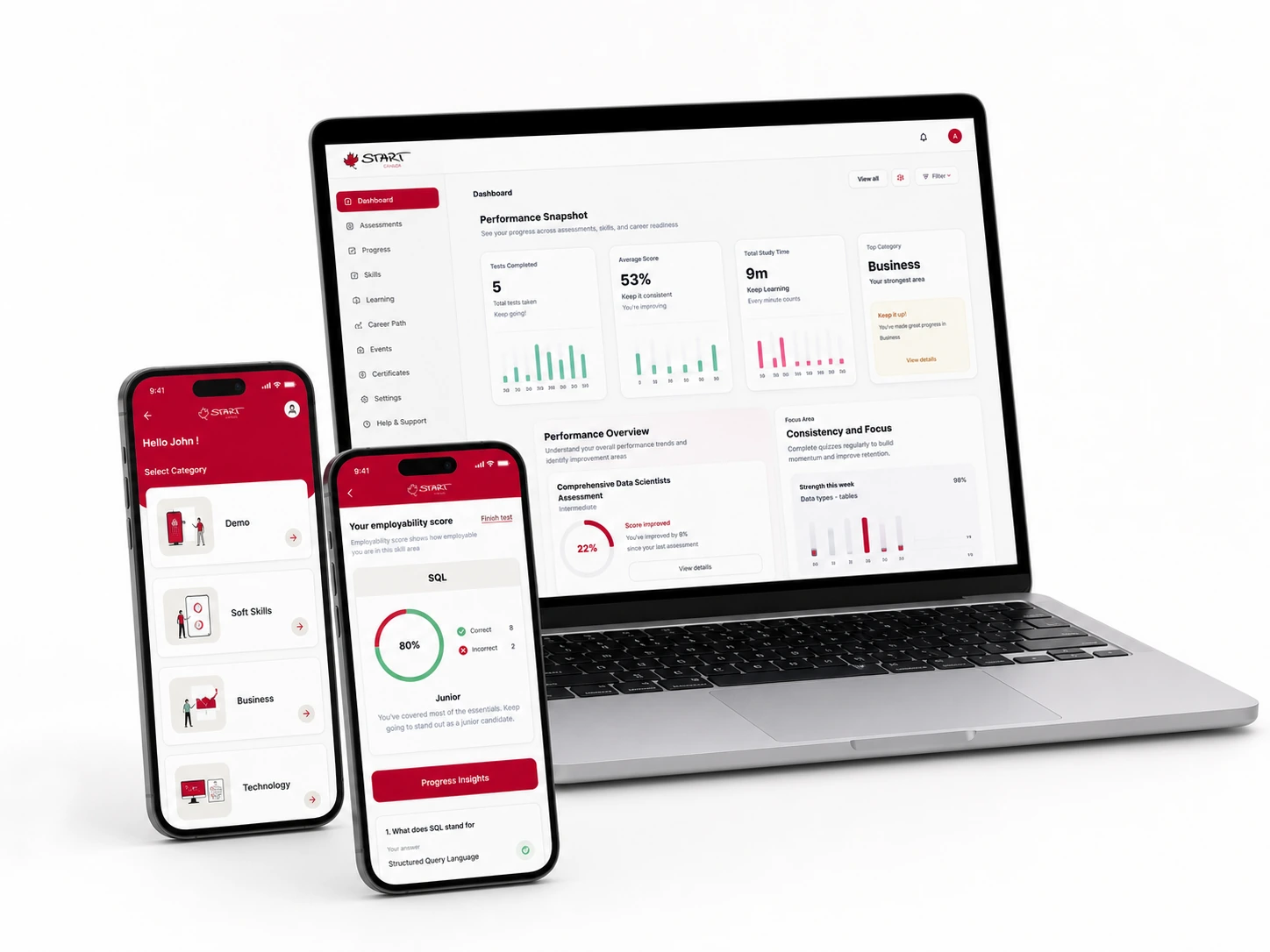
That is the job START Canada is built for. The Employability Score Platform has more than 10,000 assessment questions across technology, business and soft skills, at Junior, Intermediate and Expert levels. Learners can verify themselves against a specific job role and see their strengths and gaps the moment an assessment ends. For a college, START sets up:
- a white-label web portal in the college's own branding
- custom assessment questions for its programs
- a separate admin portal showing completions, average scores, weakest skills and the learner roster
- placement of each learner with the college by email domain
- a rollout that START manages
Learners can then build a Professional Profile and earn a certificate that a START reviewer checks before marking it START verified, so an employer sees a confirmed role and readiness score instead of a self-reported claim. When the data shows a gap, Career Readiness Bootcamps in Python, data visualization, job-search strategy and other topics give students a next step. Bootcamp participants report 95% satisfaction.
START is not a job board. A college already running Handshake, Outcome or Symplicity for postings would keep it and add START to measure and prove readiness.
Side-by-side comparison
| Platform | Main job | Who uses it | Canadian presence | Pricing signal |
|---|---|---|---|---|
| Handshake | Job board, events, employer network | Career centres, students, employers | Schulich School of Business, York | $10,000 a year plus tax at UW Tacoma, Jan 2026 |
| Orbis Outcome | Co-op, postings, appointments, WIL tracking | Co-op and career offices | Built in Canada, owned by Symplicity; UVic, U of A, Sherbrooke, Memorial | Not published |
| Symplicity CSM | Career services management | Career offices | Humber Polytechnic | Not published |
| VMock | AI resume, cover letter and pitch feedback | Students, career advisers | Haskayne, University of Calgary | $13,250 one-time FY2024 request, University of Houston |
| Big Interview | Interview lessons and practice | Students, career centres | McMaster | Individual plans from $39 for 30 days |
| Quinncia | AI resume and mock interview assistant | Career centres, faculty, students | York University logo on its site | Not published |
| Riipen | Employer projects for WIL | Faculty, students, employers | Centennial College through 2028 | Free for organizations |
| START Canada | Skills assessment, readiness scores, verified certificates | Learners, career and program staff, employers | Canadian company, StartNew Technologies | Contact START |
The price signals come from the public documents linked above, checked in October 2026. Institutional pricing is usually quoted per campus, so treat these as a sense of scale, not a rate card.
How to choose
Start from the outcome you have to report. If your board wants placement numbers, you need clean employer and posting data. If it wants to know whether graduates are job-ready, you need a measurement, and you need it before graduation.
Then ask every vendor the same questions:
- What can staff see at the cohort and program level, and can we export it?
- Can we add our own content, such as questions or projects tied to our programs?
- Where is student data stored, and who can see an individual student's results?
- Which Canadian colleges use it now, and can we speak with one?
- How many staff hours does it take each week after launch?
- Is the price per student, per module or flat, and what changes at renewal?
- Does it connect to the systems we already run?
Question 5 is the one teams forget.
For more on how colleges and employers can use readiness evidence together, read how institutions and employers measure career readiness.
Frequently asked questions
What is the best career readiness platform for a Canadian college?
No single tool covers everything. Pick by job: Orbis Outcome, Symplicity or Handshake for postings and co-op, VMock, Big Interview or Quinncia for practice, Riipen for WIL projects, and START for measuring readiness. Many colleges combine two or three.
Handshake vs VMock vs Big Interview: which does what?
Handshake is a job and events platform that connects students with employers. VMock gives AI feedback on resumes, cover letters and elevator pitches. Big Interview is mainly interview practice, with lessons and AI feedback on recorded answers. They overlap very little.
How much do career readiness platforms cost a college?
Few vendors publish institutional prices. Public budget documents give a sense of scale: $10,000 a year plus tax for Handshake at UW Tacoma, and a one-time $13,250 request for VMock at the University of Houston. Colleges should expect a quote.
Can a college measure career readiness instead of just tracking activity?
Yes, with assessments mapped to the skills its programs teach. START gives each learner a score by area and level, and gives staff a cohort view of completions, average scores and weakest skills. That is the kind of evidence program reviews and employer advisory committees ask for.
If you lead career services or a program area and want to see what a branded portal and custom questions would look like for your students, the institutions page explains the setup. You can also contact the START team to talk through your programs.
START Canada Team
The START Canada Team shares current information about the projects, training, and career-readiness tools described on startnew.ca.